

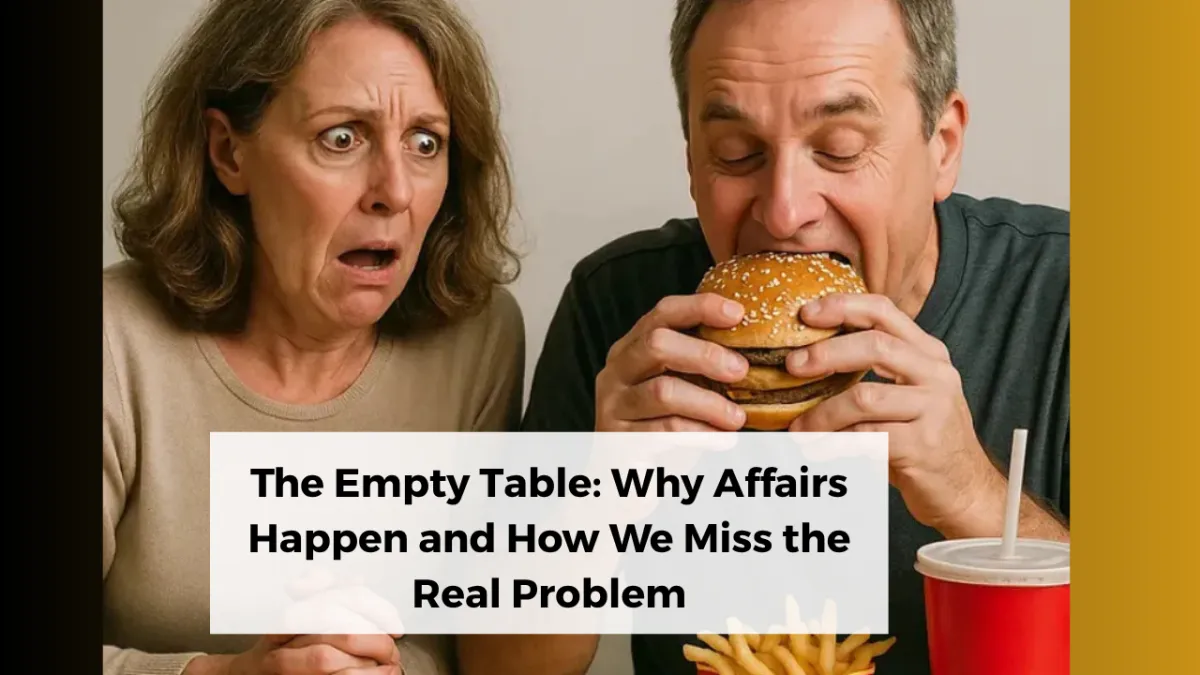
The Empty Table: Why Affairs Happen and How We Miss the Real Problem
I want you to imagine this admittedly improbable scenario.
You haven’t eaten for a week. Maybe two.
You can’t remember anymore because the hunger has become so familiar, you’ve forgotten what fullness feels like.
You’re weak, exhausted, unable to focus on anything except the gnawing emptiness in your gut. Your hands shake when you try to write. Your mind loops endlessly around food, around eating, around the pain.
And there’s your husband, sitting right beside you at the same empty table where you’ve both been starving for goodness knows how long.
Except now — NOW — he’s eating a Big Mac meal.
The smell of those fries fills the room. The wrapper crinkles as he unwraps the burger. Grease drips down his fingers as he stuffs his face with junk food.
The rage that fills you is volcanic.
How DARE he?
You’re both starving. You’ve both been starving.
But you, YOU would never stoop so low.
YOU have standards.
YOU have self-control.
You would rather stay hungry than shove that poisonous junk into your body.
So instead of finding real food — instead of walking to the kitchen and making yourself a nourishing meal — you sit there in your hunger, watching him eat his junk food, getting emptier and angrier by the second.
Your entire world narrows to his betrayal of the starvation pact you didn't even know you'd both signed.
This is what can happen in a marriage where both people have become emotionally starved.
Except the starvation isn't physical.
It's emotional.
The Starvation You Don't See
Let me paint you a picture of the average long-term marriage.
You met in your twenties, maybe early thirties. You were going to be different from your parents.
You were in love — real love — not that settled, resigned thing you watched growing up. You had passion. You had dreams. You had sex on Sunday mornings and inside jokes no one else understood.
Fast forward two decades.
The mortgage on the house takes both your salaries to maintain.
The kids need braces, university funds, travel sports fees that could fund a small country.
You've sat through more school concerts and sports events than you can count, always side by side but rarely actually together.
Your conversations revolve around logistics:
Who's picking up Emma from practice?
Did you call the plumber?
We need to move money from savings for the car repair.
When was the last time someone looked at you — really looked at you — and saw YOU?
Not Mum. Not wife. Not household manager or appointment scheduler. Not the person who remembers that registration for summer camp opens at midnight and you better be online or all the good weeks will be taken.
When was the last time you felt cherished? Desired? Fascinating?
When did someone last ask about your dreams — not your plans for the weekend or your thoughts on the new school superintendent — but your actual dreams?
The ones you've buried so deeply you've almost forgotten they exist?
You may be emotionally starving.
And your husband may be too.
The Empty Emotional System
Here's what nobody tells you about emotional needs:
They're not optional.
They're not luxury items for people with too much time on their hands.
The emotional system — that need for connection, validation, appreciation, desire, understanding and yes, unconditional love — is a fundamental part of being human.
It doesn't care that you're a grown-up with responsibilities. It doesn't care that you should be "past all that." And it certainly doesn't care that "real life isn't a romance novel."
When your emotional system is running on empty, it starts sending signals.
But here's the cruel part:
We've been taught to ignore those signals, especially in marriages that "work" on paper. Your marriage isn't abusive. You're not throwing plates. You show up for each other's work events. You're good parents. You're responsible adults.
So why would you complain about feeling empty?
What right do you have to hunger for more when you already have so much?
So you push it down. You tell yourself this is what marriage looks like after 20 years. This is maturity. This is real life. The fairy tale was always a lie, and you're smart enough to know better.
But emotional hunger doesn't disappear because you ignore it.
It can get louder.
It starts affecting everything.
You become irritable.
You snap at the kids.
You find yourself crying in your car in the supermarket car park for no reason you can quite name.
You scroll through Instagram watching other people's lives, other people's anniversaries, other people's joy — and you feel that hunger so acutely it takes your breath away.
Your husband may be emotionally hungry too.
But men are often taught even more strictly to ignore emotional hunger.
He's been told his whole life that needing emotional connection makes him weak, needy or "not a real man."
So his starvation may look different.
He withdraws.
He works longer hours.
He loses himself in fantasy football or video games or endlessly scrolling his phone.
He stops trying to connect because trying and failing can feel worse than not trying at all.
And gradually, you can both find yourselves sitting at the same empty emotional table, both hungry, both struggling, both pretending everything is fine.
When Someone Breaks
And then one day, one of you breaks.
In this case, it was him.
Maybe it was the new woman at work who laughed at his jokes — really laughed, not that polite acknowledgment you give now.
Maybe it was someone online who made him feel seen, desired and interesting again.
Maybe it was an old girlfriend who reached out on Facebook, and suddenly he remembered who he used to be before the mortgage and the minivan and the million small surrenders that led him here.
And suddenly there was something on offer.
Attention. Excitement. Validation. Desire. Connection.
The affair — because that's what we're talking about, isn't it? — became the equivalent of McDonald's.
It's junk food. Empty calories that taste amazing in the moment but leave you sick and more hungry than before.
It's not real nourishment.
It's not sustainable.
But when someone has been emotionally hungry for a long time, that junk food can feel incredibly powerful.
The attention. The excitement. The secret texts. The feeling of being wanted again.
It can flood an empty emotional system like sugar hitting the bloodstream and for the first time in years, perhaps decades, he doesn't feel empty. He feels alive.
And this is where we need to be very clear.
Understanding why someone was vulnerable to an affair is not the same thing as excusing the affair.
He had choices. He could have spoken. He could have asked for help. He could have told you he was struggling. He could have sought healthy connection. He could have left the marriage before becoming involved with someone else.
The affair was his choice, and he is responsible for that choice.
Understanding the hunger simply helps us understand the bigger picture.
The Betrayed Wife's Starvation
And you?
You discover the affair, and your entire world implodes.
But here's what makes it even more complicated:
You may still be emotionally hungry.
In fact, you may feel more starved now because the betrayal has taken even the scraps of connection you had left.
The man who was supposed to be your partner — the person you thought you could trust — has gone and fed himself somewhere else.
With junk food, yes. With something destructive, absolutely. But he fed his hunger while you stayed faithful to the famine.
The rage is indescribable.
It's not just about the sex. Or the lies. Or even the betrayal. It's that he filled his emptiness.
He took care of his hunger while you sat there being "good," being "faithful," being "mature" and suffering in silence.
You played by the rules of starvation while he cheated — literally and figuratively.
So what do you do?
If you're like many betrayed wives, you focus all your energy on his transgression.
You become the food police. You interrogate him about every detail of his junk food binge. What did she look like? What did they do? Where did they go? How could he? Why would he? Doesn't he understand how devastating his choice was?
You join support groups where other betrayed wives talk about their husbands' affairs. You read books about affair recovery that focus on him fixing his behaviour. You demand he go to therapy to figure out why he made such a destructive choice. You install monitoring apps to make sure he's not sneaking fries on the side.
And some of those things may have their place.
But there's a danger.
You can become so focused on what he ate that you forget that you're still hungry too.
You are still empty.
You are still starving.
The Truth Nobody Wants to Hear
Here's the truth that may be hard to swallow but it's true even so:
His affair is not the whole problem.
It is a massive problem.
It is a devastating choice.
It causes real damage.
And it must be taken seriously.
But sometimes the affair is also a flashing neon sign pointing towards problems that existed long before discovery.
Perhaps you'd both normalised emotional emptiness for years.
If you focus only on the affair while ignoring the emotional starvation that existed before it, you may miss an opportunity to understand what needs to change.
Because even if he never has another affair, you don't want to simply return to the marriage you had before.
You want something different. Something healthier. Something more honest.
Something where neither of you is sitting at an empty table pretending you're not hungry.
The Harder Path: Feeding Yourself
The answer isn't to keep starving while hating him for eating garbage. And it isn't to go and eat garbage yourself.
It isn't even to wait for him to feed you with the "right" kind of emotional food.
The answer — the incredibly difficult, unfair, shouldn't-have-to-be-this-way answer — is to start taking responsibility for your own emotional nourishment.
Healthy food.
This is where the metaphor might feel like it breaks down.
Because in real life, you can walk to the kitchen and make yourself a healthy meal.
Emotional nourishment isn't that simple.
You've been taught your whole life that needing emotional nourishment makes you needy, selfish or weak.
You've been taught that a good wife, a good mother, a good woman feeds everyone else first and subsists on whatever's left.
Which is usually nothing.
But feeding yourself emotionally can look like this:
It looks like talking about YOUR lifelong pain, not just his betrayal.
It means exploring why you've accepted emotional starvation as normal for so long.
It means learning to identify what emotional nourishment actually looks like for you.
It means connecting with people who see you as a whole person, not just as half of a couple or someone's mum.
It means learning to give yourself the validation you've been desperately seeking from him.
Learning to appreciate your own strength, your own beauty and your own worth without needing someone else to confirm it.
This isn't about becoming so self-sufficient that you don't need anyone. Humans are wired for connection. It's about becoming emotionally full enough that you can choose connection from a place of strength rather than desperation.
It's about not being so desperately empty that you'll accept crumbs and call them a feast.
And it looks like having standards. Perhaps for the first time in your life, being able to say:
"This is what I want from a marriage. And if that's not what you want too, tell me honestly so I can make a choice."
What This Means for Your Marriage
When you begin feeding yourself emotionally, something interesting can happen.
You gain clarity. The desperate, angry fog of starvation can begin to lift, and you can see your situation more clearly.
You may begin to understand that your husband was also struggling with emotional emptiness. You may begin to see that he was lost and looking for something he didn't know how to ask for or you may discover that he's not willing to do the work. That he's more comfortable in the emptiness than in the vulnerability of genuine connection. That his emotional patterns began long before you met. That his defences are so strong he can't — or won't — do what is necessary to change.
Either way, you begin to see more clearly.
And from that clarity, you can make real decisions about your future.
Not reactive decisions born from hunger and rage.
But thoughtful decisions about what kind of marriage you want and whether both of you are willing to create it.
The Conversation We Should Be Having
If I could sit down with every long-term couple whose marriage has moved from passion to logistics, every marriage that looks good on the Christmas card but feels empty behind closed doors, here's what I'd want to say:
You're not crazy for feeling empty.
You're not selfish for wanting more.
You're not weak for needing emotional connection.
And you're certainly not asking too much by wanting unconditional love.
These aren't bonuses for people who have their "real" responsibilities handled.
They're fundamental human needs.
The affair — when there has been one — is not be simply about sex or even about the other person.
It is an attempt to fill an emotional void that has become painful.
But understanding is not absolution.
An affair is still a choice.
A destructive choice.
A choice that hurts the betrayed spouse, the marriage, the family and ultimately the person who made it too.
The goal isn't to police each other's eating habits while you both starve.
And it isn't to become so self-sufficient that you don't need emotional nourishment from your partner.
It's to recognise that you may both have been hungry for a very long time.
And it's time to start seeking real, sustainable, healthy emotional nourishment.
Starting Today
So where do you start?
Right here. Right now. With this recognition: Your emotional emptiness is real.
Your hunger for connection, appreciation, desire and love is valid.
You're not crazy. You're not needy. You're not asking for too much.
You're a human being with fundamental emotional needs, and perhaps you've been trying to survive on emotional crumbs for far too long.
Whether your husband joins you in seeking REAL nourishment or continues with his own destructive patterns…
Whether your marriage survives, transforms or eventually ends… your job is to start taking care of your emotional health.
To stop accepting starvation as normal.
To stop judging yourself for being hungry.
And to stop believing that understanding his betrayal means you have to ignore your own emptiness and pain.
Because perhaps the question isn't simply: "How do we recover from his affair?"
Perhaps the deeper question is: "How do we build a marriage where neither of us is starving anymore?"
That's a very different conversation.
And it may be the conversation that changes everything.


